Mary Lee Taylor Cooking
The Woman Behind the Voice
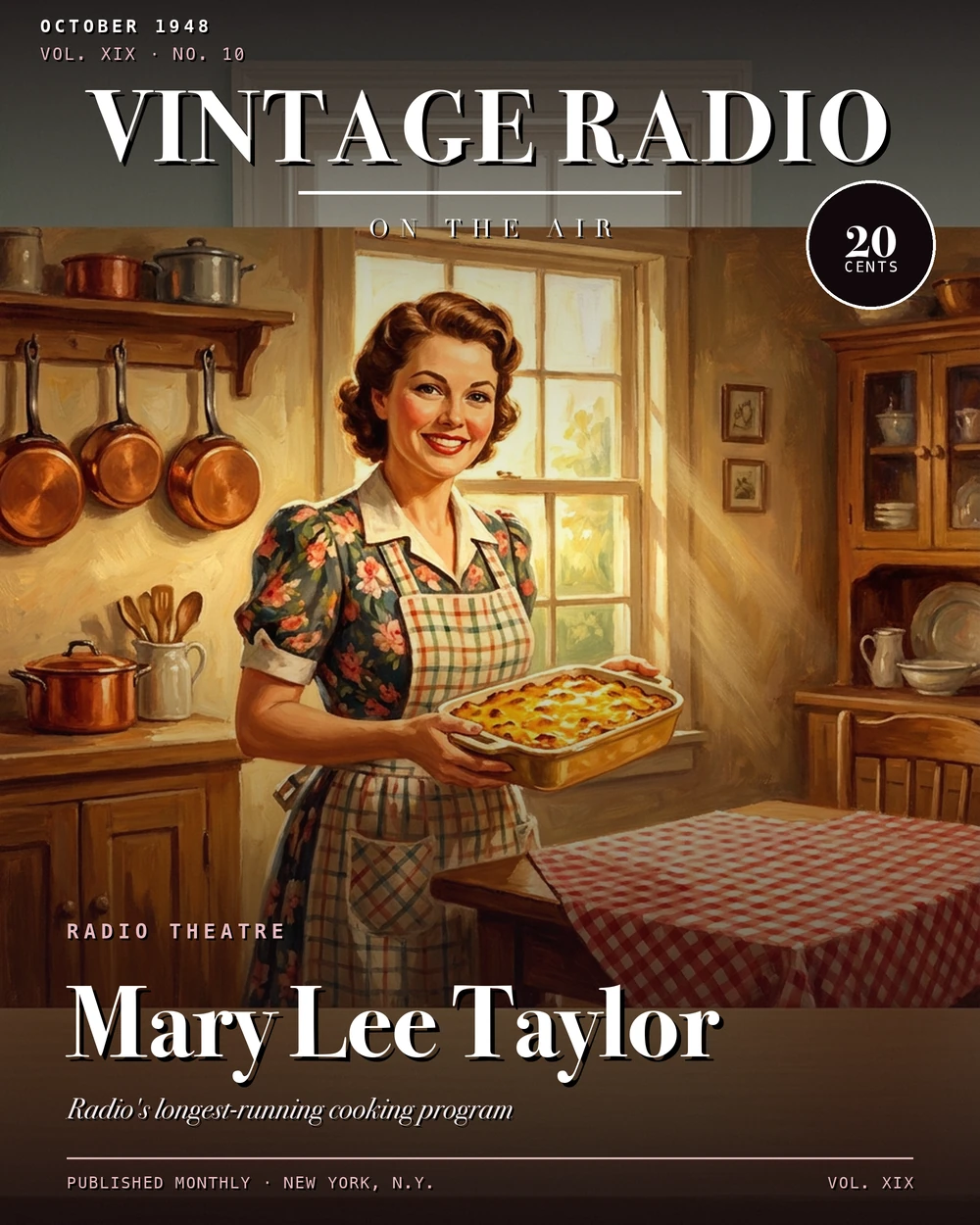
Mary Lee Taylor was never a real person. That's the most striking thing about this show, and the fact that sits at the center of everything else. The woman who introduced herself to American homemakers as a "nutritionist and home economist" for the PET Milk Company was actually Erma Perham Proetz, an advertising copywriter and executive at the Gardner Advertising Company in St. Louis, Missouri. She created the Mary Lee Taylor persona from scratch, built a test kitchen in St. Louis to develop the recipes that would go on air, and turned a struggling brand into a national presence — all while presenting herself under a name that wasn't hers.
Proetz was born in Denver, Colorado in 1891, graduated from Washington University in St. Louis, and started her journalism career at a St. Louis trade publication called the Dry Goods Economist. Gardner Advertising recruited her in 1923 specifically to revive the PET Milk brand, which was reportedly "in trouble" at the time. She was good at it. By 1935, Fortune magazine named her one of the 16 outstanding women in American business, and she eventually rose to Vice President and then executive vice president at Gardner. At its peak, the show aired simultaneously on 200 radio stations. Proetz built all of that.
She died on August 7, 1944, at 53 years old. The show she created continued for another decade without her, finally ending on October 9, 1954. Who voiced Mary Lee Taylor after 1944 was never publicly disclosed. One researcher noted that "the folks at PET Milk aren't saying," and PET Milk itself doesn't mention the radio program in its corporate history. The persona outlived its creator by ten years, and the name behind the voice remains unknown.
In 1952, Proetz was inducted into the Advertising Hall of Fame as its first female inductee, a posthumous recognition for work she had completed years earlier. Washington University in St. Louis named the Erma Proetz Memorial Scholarship at the Sam Fox School of Design & Visual Arts in her honor.
How the Show Was Built
The program premiered on November 7, 1933, on CBS — right in the middle of the Great Depression. The timing shaped everything about its early approach. The show targeted homemakers directly, emphasizing economical, budget-conscious recipes built around PET Milk products. It wasn't positioned as aspirational cooking; it was practical cooking for households watching every dollar. Pet Milk sponsored the show for its entire run, first on CBS and then on NBC, making it one of the most sustained single-sponsor arrangements in radio history.
During its CBS years, the show aired twice a week at 11 a.m. in 15-minute episodes, a format it held until 1943. That year, it expanded to a 30-minute Saturday morning slot at 10:30 a.m., and the extra time allowed the program to take on a more ambitious structure. The show moved to NBC beginning October 23, 1948, initially airing Saturdays at 10 a.m. before shifting to 10:30 a.m. after 1949, where it stayed until the end of its run in 1954. The CBS run ended on October 16, 1948, just a week before the NBC debut, suggesting a deliberate handoff rather than a gap.
The whole enterprise was, from the beginning, a product of advertising rather than traditional radio production. The Mary Lee Taylor character and her radio presence were conceived and managed entirely through Gardner Advertising as a promotional vehicle for PET Milk. There was no independent radio producer in the usual sense — the show existed to sell canned milk, and everything about its format, its persona, and its content served that purpose.
What Was Actually in Each Episode
The 15-minute CBS-era episodes were straightforward cooking segments: recipes, tips, meal plans, and cookbook promotions, all integrated with PET Milk products. One of the most frequently cited recipes from the show was pumpkin pie. The content emphasized practical household economy — not just individual recipes but full meal planning advice and housekeeping guidance.
When the show expanded to 30 minutes, the structure changed substantially. The first half became a domestic drama segment called "The Story of the Week," roughly 15 minutes long, centered on a young married couple named Jim and Sally Carter. These storylines had a lot in common with radio sitcoms — marital jealousy, neighborly tensions, the texture of everyday domestic life. They weren't cooking segments at all. The second half of each episode was "The Recipe of the Week," where Mary Lee Taylor presented cooking tips and PET Milk-based recipes. On NBC, episodes also concluded with a segment called "Today's Recipe for Happiness," in which Taylor offered brief philosophical observations to listeners — a soft, homespun close to the program.
The NBC version has been described as "an unusual but effective generic hybrid," which is a fair assessment of a show that was simultaneously a cooking program, a domestic drama, a recipe demonstration, and a philosophical aside — all in 30 minutes. The show was introduced on NBC informally as "Mary Lee on NBC" and was promoted as part of what the network called its "Saturday morning parade of stars."
A surviving episode from June 18, 1949 — a Father's Day installment — illustrates the show's practical register. It presented a complete meal plan: braised round steak, fried potatoes and green beans, vegetable slaw, rolls and butter, vanilla ice cream with chocolate sauce, and coffee. The total cost for four people, using PET Milk, came to $2.06.
The Recipe Booklets and the Wider Campaign
The show didn't stop at the radio. Beginning in the 1940s, listeners could write in for free PET Milk recipe booklets, and the show regularly promoted these mailings on air. One booklet was titled "Everyday Dishes that Taste Like More." A 1949 pamphlet called "Husband-Tested Recipes from Mary Lee Taylor's Pet Milk Kitchen" ran 32 pages, was sized roughly 6" x 8.5", and was designed to be added to a binder — a detail that suggests how the show's producers thought about their audience's relationship with the material. These weren't throwaway promotional pieces; they were meant to be kept and used.
A 1953 recipe pamphlet titled "Quick, Easy Recipes by Mary Lee Taylor — PET Milk Program" was published by the Sego Milk Products Company of Salt Lake City, Utah. Around 1950, a promotional piece advertised both the PET Milk Radio Program starring Fibber McGee and Molly and Mary Lee Taylor's "Recipes and Stories of the Week" on the same back-cover advertisement, indicating how PET Milk managed its radio portfolio as a coordinated effort.
The multi-media strategy surrounding the show — radio broadcasts, print advertising, and recipe booklet collateral all working together — was considered an innovative integrated marketing approach for its era. The St. Louis Media History Foundation maintains an artifact record for the show, listing it alongside announcer Don Cole and PET Milk.
Why It Ran So Long
Twenty-one years on radio is a long run by any measure. The show is consistently described in old-time radio literature as the longest-running cooking program in the medium's history. Several things contributed to that longevity. Pet Milk never left — the sponsor relationship held for the entire run across two networks, which removed one of the most common reasons shows ended. The format evolved as radio itself changed: the expansion to 30 minutes and the addition of the domestic drama segment kept the show current with what audiences expected from morning programming as the 1940s progressed.
There's also the persona itself. Mary Lee Taylor was a consistent, reassuring presence in Saturday morning households for over two decades. The fact that Proetz died in 1944 and no one publicly knew who was voicing the character afterward speaks to how thoroughly the persona had been built to exist independently of any single person. The character was the brand, and the brand was strong enough to carry the show forward for another ten years after its creator was gone. As a document of how advertising, persona creation, and practical household broadcasting intersected in mid-century American radio, the Mary Lee Taylor Cooking program remains a distinct and genuinely unusual chapter in the medium's history.